
25 Years Ago at UULansing: February 2001, A Church Alive with Energy
by Ed Busch, UU Lansing Archivist
Setting the Scene: February 2001
In February 2001, the United States was settling into a new political chapter marked by uncertainty. George W. Bush had been inaugurated just weeks earlier following a deeply contested election, and national conversations reflected political division alongside questions of leadership, unity, and direction.
In Michigan, the state was beginning to feel early signs of an economic slowdown after the long growth cycle of the 1990s. Public institutions—including universities, nonprofits, and faith communities—were increasingly important spaces for dialogue, reflection, and civic engagement. In the Lansing area, Michigan State University anchored the region, and churches like the Unitarian Universalist Church of Greater Lansing served as gathering places for social justice work, spiritual exploration, and community connection.
It was in this broader context that UULansing entered 2001 with notable momentum and confidence.
The February 12, 2001 issue of The Liberal Express offers a vivid snapshot of that moment in congregational life.
“Guess Who I Saw at Church — Bob Lovell”
The lead article of the newsletter was not about a national issue or even a major program. It was a profile of the congregation’s Board President, Bob Lovell.
Titled “Guess Who I Saw at Church — Bob Lovell,” the article opens with a bit of playful timing:
“We might have trouble saying ‘President Bush,’ but we do have one President we can feel good about—Bob Lovell.”
The profile paints a picture not only of Bob’s professional accomplishments, but of his humanity. Raised in an Air Force family, he lived in multiple states—including Hawaii, his favorite—before studying math at Colorado College and earning a master’s degree at Michigan State University. He went on to work 25 years as a statistician with the state and later taught at Lansing Community College and Western Michigan University.
The article also shares the personal details that make a church profile distinctive: his wife Kathy, a Ph.D. in biophysics at MSU; their daughter Jennifer; two cats named Albert and Marie; a fondness for comic books and model trains; and, delightfully, that his “inner child is also a big fan of Crayolas.”
In February 2001, Bob was serving his second term as President of the Board and also co-leading the high school group. The prominence of this article tells us something about the congregation’s culture: leadership was relational, visible, and appreciated.
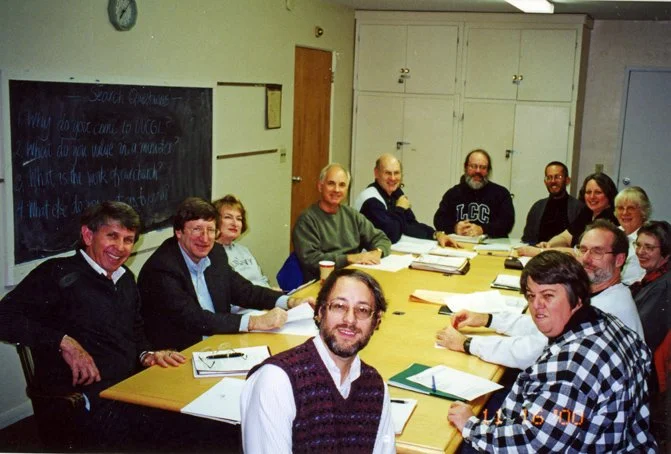
Board of Trustees, November 2000 - (Left around table to right)- Rev Wayne Robinson, Jim Smith, Jane Whittington, Ed Loomis, Ken Zielinski, Bob Lovell, Marcus Cheatham, Regina Fry, Pearl Ann Miller,Dot Thorburn, David Hill, Lauren Thomas, Chris Clampitt
Worship Life and the Interim Minister’s Perspective
At this time, Rev. Wayne Robinson was serving as interim minister, and his regular newsletter column, Wayne’s Words, offers an especially rich portrait of congregational life.
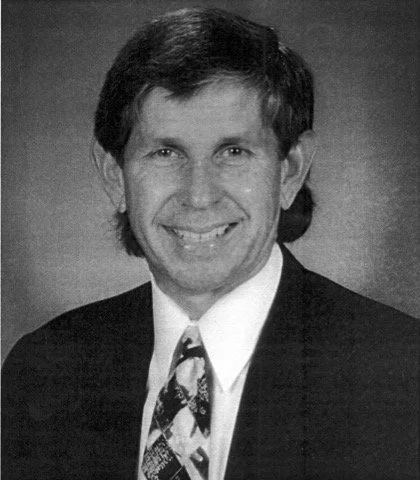
Rev. Wayne Robinson
Looking back on the Martin Luther King Jr. Sunday service in January, Robinson describes a sanctuary overflowing with people and energy:
“The church was packed, the music great, and the energy palpable.”
He paints a vivid picture of intergenerational worship:
“There were children of all ages seated throughout the congregation, and senior highs filling the back row in the fireplace room.”
So many people attended that extra chairs were pressed into service:
“I kept thinking every chair we own was in use, and yet people kept finding chairs from downstairs or upstairs to bring in.”
For an interim minister, the experience was deeply affirming:
“It really makes coming to church as the minister something to look forward to. I’m always excited about each service.”
Growth from the Inside Out
February 2001 also marked structural changes and expanding participation. The congregation had just moved to two Sunday morning services, and engagement across programs was strong.
Rev. Robinson wrote:
“We went to two services on Sunday morning, we had three classes of Journey Toward Wholeness meeting weekly, some 20 plus people are showing up for care team training, and 28 people are meeting for Building Your Own Theology.”
He emphasized that this vitality did not come from any one program or leader:
“You have a church that is strong from the inside out: the best kind!”
He returned repeatedly to the idea that shared effort mattered more than individual accomplishment:
“The results of working together are so much greater than the results of working independently.”
Black Awareness and Worship with Purpose
February’s worship theme was Black Awareness, reflected both in Sunday services and in broader programming. Robinson names the figures highlighted that month:
“Muhammad Ali, Malcolm X, James Baldwin, and Paul Robeson make unique perspectives for looking at the meaning of our African American heritage.”
These services aligned closely with the congregation’s participation in Journey Toward Wholeness, an anti-racism program that invited members to explore cultural heritage, unearned privilege, and the vision of an anti-oppressive, multicultural congregation.
Courtesy, Maturity, and Congregational Culture
In a continuation of Wayne’s Words later in the issue, Robinson reflects on what he believed made UULansing distinctive. One quality he names is courtesy:
“We treat each other as persons of equal standing and worth—including the minister.”
He also notes something the congregation did not do:
“We don’t bash other religions, especially the one we came from.”
For Robinson, this was a sign of theological maturity and confidence—an ability to stand firmly in Unitarian Universalist values without defining identity through opposition.
Faith Beyond the Walls
The newsletter also documents the congregation’s outward-facing commitments. Members were encouraged to support earthquake relief efforts following the devastating January 2001 earthquake in Gujarat, India. The church promoted community forums addressing the experiences of the “Lost Boys” of Sudan and regional workshops on reparations and racial justice.
These efforts reflect a congregation attentive to global suffering and committed to action beyond its own walls.
A Moment of Transition
As an interim minister, Robinson was candid about transition. In this issue, he shared that he had withdrawn from the UU settlement process and planned to return to Florida to help build a new liberal religious congregation. He framed the decision as one shaped by courage—and by his time in Lansing:
“This year has been tremendously important in giving me the courage to make such a radical decision.”
Remembering Together
As we look back 25 years later, this issue of The Liberal Express offers more than a record of meetings and events. It captures a congregation alive with energy, trust, participation, and shared purpose during a time of change.
If you were part of UULansing in 2001, you may remember crowded services, long conversations after potlucks, or your own involvement in Journey Toward Wholeness, music, or committee work. I invite you to share your memories from that time—what stands out for you, what shaped your experience, and what you carried forward. Our collective recollections help bring the archive to life.
As Rev. Robinson observed in 2001, it is often the “synergy” of shared effort that defines a congregation — and memory is part of that shared work.
You can share materials or comments by emailing uucgl.archives@gmail.com.
About Me
I’m a member of the Unitarian Universalist Church of Greater Lansing and serve as the volunteer archivist for our congregation. I’m retired from Michigan State University, where I worked in digital preservation and archives. I enjoy uncovering stories from church newsletters, board records, and local history sources to help connect our past with the present.
I also serve on the UU Lansing Stewardship Team and help with Building and Grounds.
This piece was developed with research assistance and editorial support from ChatGPT.
Source:
Liberal Express newsletter, February 12, 2001, UU Lansing Archives.