
January 1972: Truth, Patriotism, and Congregational Life at UU Lansing
by Ed Busch, UU Lansing Archivist
This archive post draws from the January 7, 1972 newsletter of the Unitarian Universalist Church of Greater Lansing.
January 1972 opened amid national unease and moral questioning. The Vietnam War continued despite growing public opposition, civil rights and economic justice remained unfinished work, and the country was entering a presidential election year shaped by protest, patriotism, and distrust of easy slogans. These tensions were felt not only on the national stage, but in congregations like the Unitarian Universalist Church of Greater Lansing—where questions of truth, justice, and conscience regularly found their way into worship and community life.
Looking Back: January 1972 at UU Church of Greater Lansing
Church President: Marion Walsh
Minister: Rev. Robert Edward Green
As we open the church archives for the new year, we turn to the first January 1972 newsletter—a rich snapshot of congregational life and a moment when national debates about patriotism, justice, and social responsibility found their way directly into the pulpit.
A Minister Speaks: Rev. Robert Green on Patriotism and Reality
Rev. Robert Green’s Minister’s Message is striking for its clarity, humor, and moral urgency. He responds to a proposal then moving through the Michigan Legislature: a newly adopted Pledge of Allegiance to the Michigan state flag.
The proposed pledge began:
“I pledge allegiance to the flag of Michigan and to the state for which it stands, two beautiful peninsulas united by a bridge of steel, where equal opportunity and justice to all is real.”
Rev. Green does not mince words. He calls the pledge “ludicrous” and challenges both its symbolism and its claims. While acknowledging the beauty of Michigan’s two peninsulas, he asks pointedly:
“Does the Mackinac Bridge really require that kind of idolatry?”
More sharply, he questions the pledge’s assertion that “equal opportunity and justice to all is real.” He reminds readers of unemployment, discrimination, poverty, and regional inequality—particularly in the Upper Peninsula—and asks how anyone could repeat such words “with a clear conscience.”
Rev. Green contrasts the Michigan pledge with the familiar national one, admitting that even “liberty and justice for all” can be difficult to say honestly, yet noting that it can at least be understood as an ideal toward which we strive, rather than a claim already fulfilled.
He closes with exasperation and wit:
“Surely they must be at least somewhat aware of what exists in their constituency.
Good grief!”
Signed simply, – REG, the message reflects a minister—and a congregation—deeply engaged with questions of conscience, truth-telling, and civic responsibility at the start of 1972.
Worship and Religious Life
On Sunday, January 9, 1972, the congregation gathered at 10:30 a.m. for a service titled:
“From ‘1980 Ltd.’ to ‘Yesteryears’”
That morning also included a Service of Dedication of Children, sometimes called a naming ceremony or baptism—an early reminder of the congregation’s commitment to welcoming families and marking life passages.
College students were invited to an evening SRL (Student Religious Liberals) meeting, reflecting the church’s active engagement with the wider university community. The event drew notice beyond the congregation and was also reported in the Lansing State Journal on January 8, 1972.
The newspaper described the gathering as “a discussion of liberal religion and its approach to the problems of life and society,” open to interested college students. The featured talk, titled:
“Loss and the Generation Gaps, or Your Parents Are Alienated Too,”
was given by Dr. John Schneider, assistant professor of psychiatry at Michigan State University. According to the article, Dr. Schneider held dual appointments in the Departments of Psychiatry and Medical Education and had a special research interest in “cross-cultural studies of alienation.” The program included time for discussion and consideration of continuing SRL meetings during the winter quarter.
Questions children ask about religion were also on Rev. Green’s mind. He invited parents to submit their children’s questions in advance of a planned February service devoted to addressing them.
Community, Fellowship, and Learning
The January 1972 newsletter reflects a busy and interconnected church community:
Circle Dinners brought members together in homes for shared meals and conversation.
A Playreading Group met socially to enjoy dramatic works.
A Bible Analysis Group engaged in in-depth, scholarly reading of the Gospels.
A Ladies’ Bag Lunch offered midweek fellowship.
The calendar also announced a Special Congregational Meeting on January 23 to adopt the church budget for the 1972 fiscal year.
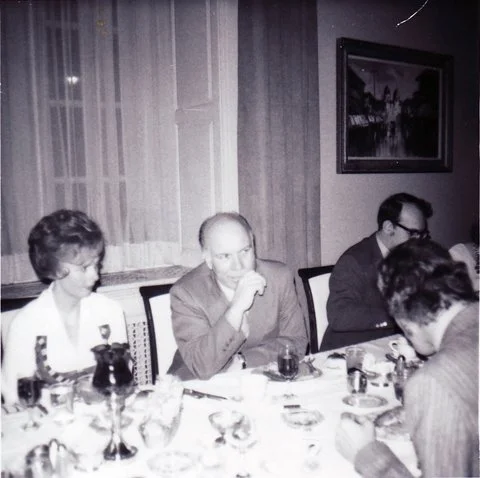
Possibly from a Circle Supper with Joan Kemper, George Lokken, and Bill Kemper in 1972. (2008.0349)
Social Action and Service
Social justice concerns appear throughout the newsletter:
The church continued collecting food for needy families, anticipating participation in the county’s emergency assistance program.
A rummage and recycling sale was planned, with a call for volunteers.
The Social Action Committee also sponsored a screening of And Another Family for Peace, a Vietnam War-era documentary by Another Mother for Peace that presents personal interviews with five U.S. families deeply affected by the war, underscoring grassroots peace activism and the human cost of conflict. (It can be viewed at https://www.c-span.org/program/american-history-tv/and-another-family-for-peace/545192 .)
Smoking cessation clinics at Sparrow Hospital were also advertised—evidence of early public health outreach.
Personal Notes and Wider Connections
The newsletter includes weddings, recoveries from surgery, travel news, and greetings from church members living abroad. One family reported from France, where studies, teaching, and advanced scientific research were underway—reminding readers that the UUCGL community extended well beyond Lansing.
The issue closes with a quotation from Dag Hammarskjöld:
“Only what you have given is salvaged from the nothing which some day will have been your life.”
Archival Sidebar: What Happened to the Michigan State Pledge?
In his January 1972 message, Rev. Robert Green reacted to a proposed Michigan state pledge that he feared would soon be adopted. His concern was well founded.
Later that same year, the Michigan Legislature formally adopted an official Pledge of Allegiance to the State of Michigan as law (1972 Public Act 165, effective June 13, 1972). Written by Harold G. Coburn, the final statutory wording reads:
“I pledge allegiance to the flag of Michigan, and to the state for which it stands,
two beautiful peninsulas united by a bridge of steel, where equal opportunity and justice to all is our ideal.”
Notably, the language enacted into law differs slightly from the version quoted in the newsletter. The phrase “is real” became “is our ideal,” shifting the pledge from a statement of claimed reality to an expression of aspiration—precisely the distinction Rev. Green argued for in his critique.
Share Your Memories
If you have photographs, documents, or memories connected to the early years of the Unitarian Universalist Church of Greater Lansing, the archives would love to hear from you. Personal recollections and images help bring these newsletters and names to life for today’s congregation.
You can share materials or comments by emailing uucgl.archives@gmail.com.
About Me
I’m a member of the Unitarian Universalist Church of Greater Lansing and serve as the volunteer archivist for our congregation. I’m retired from Michigan State University, where I worked in digital preservation and archives. I enjoy uncovering stories from church newsletters, board records, and local history sources to help connect our past with the present.
I also serve on the UU Lansing Stewardship Team and help with Building and Grounds.
This piece was developed with research assistance and editorial support from ChatGPT.