
From the Archives: “The Church and American Citizenship,” Lansing — February 1899
by Ed Busch, UU Lansing church archivist
This week’s archival find was not entirely accidental. While working on the book Dedicated Lives: 162 Years of Liberal Ministry and Its Ministers in Lansing, Michigan 1849–2011, I became familiar with Rev. Howard P. Bard through an old scrapbook filled with newspaper clippings about the early years of our church. That earlier research stayed with me.
As I prepared this month’s From the Archives post, I intentionally went back to the Lansing State Journal to see what Bard might have been preaching around this same time of year shortly after beginning his ministry in Lansing. What I did not expect — and what felt genuinely serendipitous — was his sermon topic.
On February 27, 1899, the Journal printed a detailed summary of a sermon Bard delivered the previous evening at Lansing’s Church of Our Father, the congregation we now know as the Unitarian Universalist Church of Greater Lansing. The sermon’s title was “The Church and American Citizenship.”
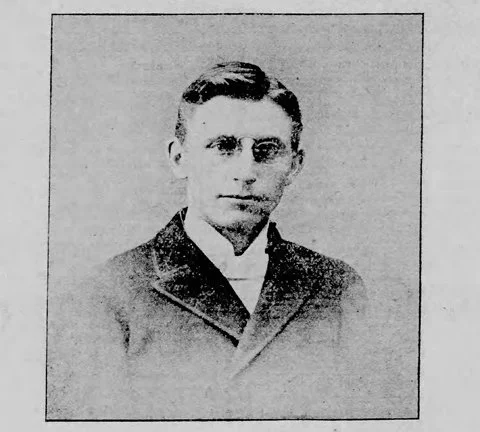
Rev. Howard Bard (Lansing State Journal, December 5, 1898, page 5.)
A Young Minister Arrives
Local readers first encountered Bard’s name a few months earlier. The Journal announced on November 4, 1898 that he had accepted the call to serve the Church of Our Father, coming to Lansing from Conneautville, Pennsylvania. He preached his first sermon here on December 4, 1898. He was only 28 years old.
Lansing at that moment was a city in motion. Electric lights were gradually replacing gas lamps. Railroads pulled the city into closer connection with Detroit and Chicago. Newspapers carried daily debates about politics, labor, education, and social reform. Nationally, President McKinley's administration was grappling with questions raised by the Spanish-American War and America's expanding role in the world — and Americans across the country were debating what citizenship meant in a rapidly changing democracy.
That was the subject Bard chose for this particular February evening.
Liberty, Enterprise, and Emerging Concern
According to the Lansing State Journal’s account, Bard began by reflecting on how Americans were viewed around the world:
“The citizen of the United States is different from any other human being on the face of the globe,” he said. “There is something in his Americanism… which make those who thrive under other flags look up to him.”
He described Americans as shaped by a “supreme love of personal liberty,” along with enterprise and energy — qualities he believed made American institutions admired internationally.
But admiration quickly gave way to concern. Bard warned that changes within American society threatened the very citizenship he praised. The newspaper summarized his concerns in direct terms:
“Partisanship is undermining the moral health of government,” he said, adding that “the lines of class distinction are being drawn more closely as time goes by.”
He also spoke about the social tensions created by rapid immigration — a subject widely debated across the country at the time and one that reminds us how deeply historical context shapes public conversation.
For Bard, these developments were not merely political problems. They were moral challenges that affected how citizens treated one another and how democracy functioned.
The Church's Role in Public Life
Near the close of the sermon, Bard turned to the role of religion itself. He rejected the idea that the church's purpose was limited to theological inquiry:
“I have gotten over the idea that the sole mission of the church is to search out who were the sons of Abraham and Isaac and Jacob.”
Instead, he argued that churches must engage the real issues of the day:
“It must cope with the national problems of the day. It must be the prophet of the hour and strengthen the people to meet and conquer the evils which threaten the body social.”
At the same time, he drew a line that still sounds familiar in UU circles:
“I do not believe the church should be partisan, but it should deal in politic.”
A Voice Across 126 Years
What makes this sermon compelling is not simply its age but its familiarity. The congregation gathered in 1899 was living through rapid change, political disagreement, and uncertainty about the nation’s future. Bard did not offer easy answers — he expressed confidence that communities grounded in moral reflection and shared purpose could help citizens meet difficult times with wisdom and courage.
Discoveries like this remind us that UU Lansing’s engagement with civic life has deep roots. Long before today’s conversations about democracy and public responsibility, this congregation was already asking how faith might help people live responsibly together in a changing world.
An Invitation
Historical finds like this are best when they spark conversation. What do you think? Send your comments and reflections to uucgl.archives@gmail.com — I would love to hear how this voice from Lansing’s past speaks to you today.
There will be no From the Archives post next week while I’m traveling, but we’ll return soon with another glimpse into UU Lansing’s past.
Each discovery in the archives reminds us that today’s congregation is part of a much longer story.
About Me
I’m a member of the Unitarian Universalist Church of Greater Lansing and serve as the volunteer archivist for our congregation. I’m retired from Michigan State University, where I worked in digital preservation and archives. I enjoy uncovering stories from church newsletters, board records, and local history sources to help connect our past with the present.
I also serve on the UU Lansing Stewardship Team and help with Building and Grounds.
Source:
Lansing State Journal, December 5, 1898, page 5.
Lansing State Journal, February 27, 1899, page 4 (summary of Rev. H. P. Bard’s sermon at the Church of Our Father)
This piece was developed with research assistance and editorial support from ChatGPT and Claude ai.