
by Ed Busch, UU Lansing Church Archivist
Fifteen years ago, November 2011 found the Unitarian Universalist Church of Greater Lansing (UUCGL) in the midst of a busy fall. The November newsletter, read alongside the October newsletter and the November 16 Weekly Digest, offers a snapshot of a congregation balancing worship, religious education, social action, fellowship and some important conversations about its future.
It was also a time of considerable change and uncertainty in the wider world.
The world in November 2011
Internationally, the Arab Spring continued to reshape the Middle East and North Africa, and Syria's uprising was turning increasingly violent. Europe's debt crisis was toppling governments: Italian Prime Minister Silvio Berlusconi resigned on November 12 amid mounting pressure over his country's finances.
In the United States, Occupy Wall Street was in its third month, bringing demonstrations about economic inequality and corporate influence to communities across the country, including a discussion of Occupy Lansing on our own Social Action Committee's agenda. The nation was following the unfolding scandal at Penn State University, the Republican presidential candidates were well into a crowded debate season ahead of the 2012 election, and a congressional "supercommittee" was struggling to reach agreement on deficit reduction.
Closer to home, Michigan was in the first year of Governor Rick Snyder's administration. On November 8, voters recalled State Representative Paul Scott, the first Michigan legislator recalled since 1983. The same day, Lansing voters approved a five-year, 4-mill millage for police, fire and road maintenance, after rejecting a millage in May.
Against this backdrop, our congregation was focused on the things that sustain a community: meaningful worship, learning, caring for one another and working together to make a difference.
A month centered on gratitude
The November newsletter opened with a message from Senior Minister Rev. Kathryn A. Bert on the month's spiritual theme: gratitude.
"Gratitude is a spiritual practice," she wrote.
Rev. Bert recalled living in Honduras "among the poorest people in the poorest country of Central America," where she heard "constant expressions of gratitude." It "startled my young adult consciousness that people with so little could be so grateful, while I, with so much, took it all for granted. It changed me forever." To this day, she wrote, it is rare that she gets water from a faucet "without recognizing the miracle of clean and plentiful water."
She also cited Tom Brokaw's new book, The Time of Our Lives, and his suggestion that a better life be measured less by "the larger home and fancier car" and more by education, contribution to society, and community.
She concluded: "During the month of November, may we remember what matters most and work to preserve and enhance it as we daily express our gratitude for the life that is ours."
It was an appropriate theme for a month that included Thanksgiving and many opportunities to gather. At 855 Grove Street, worship was held at 9:15 and 11:15 a.m. most Sundays. Rev. Bert preached "Perhaps" on November 6, and she and Teresa Putnam, Director of Lifespan Faith Development, led the annual all-ages bread and cider communion, "Breaking Bread, Giving Thanks," on November 20. Members were invited to bring bread "from your personal heritage or a culture near and dear to your heart." On November 27 there was a single service at 10:15 a.m.
A ministerial intern preparing for a milestone
The newsletter also included a candid update from Ministerial Intern Duffy Peet, who had been with the congregation "just over two months."
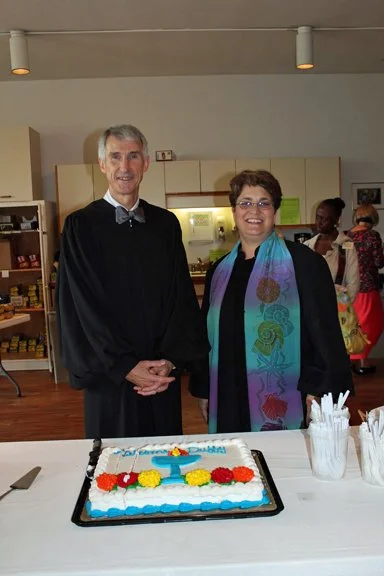
Duffy Peet, Rev. Kathryn Bert, 2011.(2001.0013).
Duffy was scheduled to meet the Unitarian Universalist Association's Ministerial Fellowship Committee (MFC) on Thursday, December 1 at 4:00 p.m. At the end of the one-hour meeting he would learn "whether I am granted preliminary fellowship as a UU minister or whether further work and development on my part will be required." It would be his second appointment. At his first, on September 25, 2010, he was told the committee "saw promise in me" but that some areas needed further attention. "The disappointment, however, soon turned to determination," he wrote.
Not being granted fellowship that first time meant he could not seek employment as a UU minister, but it also allowed him to accept the internship at UUCGL and return to "the state of my birth and the place where all of my family members still live." He thanked the congregation for "the commitment that UUCGL has made to being a teaching congregation."
He also invited members to help. He planned to write two ten-minute homilies, to be delivered the afternoon of November 20 in the Assembly Hall at 4:00 p.m., and he asked for listeners to share their thoughts. The November 16 Weekly Digest repeated the invitation: he would open his MFC meeting by delivering one of the homilies, and "you are invited to come hear him preach and share with him your observations, thoughts, and reactions."
Duffy also led worship on November 13 ("The Latitudes of Gratitude") and November 27 ("Experiencing Gratitude, Cultivating Generosity"). Elsewhere in the newsletter, he is listed as the teacher of the "Welcome to UU!" membership class.
The October newsletter shows another part of his work: he joined a UUCGL "Leap of Faith Traveling Team" that began a year-long partnership with the First Unitarian Universalist Congregation of Ann Arbor. The Weekly Digest lists the team meeting on Saturday, November 19.
Halloween, haunted houses and faith development
The Religious Education program kept the building lively.
The October 29 Halloween party transformed the Assembly Hall and Fireplace Room into "party and game central," thanks to organizers David Hill, Harmony Gmazel, Stephanie Fleming and Anastasia Shortridge. The high school youth added a haunted house built in the second-floor classrooms, which the newsletter called "a maze of chilling and very professional-looking chambers." Youth advisors Scott Rosenfeld, Kristan Small and Colleen McNeilly-Murphy were thanked, and Teresa Putnam reported that "all the spirits I saw, little and big, had a great time!"

Halloween party 2011
The youth had another event planned. For the Stone Soup Brunch on November 6, the high school youth were to make soups and bake bread on Saturday afternoon and evening and serve them after both services on Sunday. The high school group planned to sleep over at church, and the middle school Our Whole Lives (OWL) youth would spend the night too, using the extra time for several sessions of their year-long sexuality education curriculum. The newsletter thanked OWL facilitators David Hill, Marge Weldon, Terry Dennis-Kirk and Marc Breedlove, and "all the parents who are giving up a night of sleep to chaperone each group."
November's theological theme was Gratitude, woven into worship and the elementary workshop rotations, with a list of children's books for families to explore at home. Looking ahead were the Thanksgiving Bread Communion on November 20, Deck-the-Halls on December 3 (the church was hunting for "a rather tall Christmas tree"), and the December 18 pageant, The Spirit of the Christmas Tree. Children and youth rehearsed Sunday mornings with Chris Whittaker, Interim Director of Music, and Teresa Putnam was a contact for volunteers and information.
Life together: learning, fellowship and social action
The November calendar shows a remarkable range of activities.
The Sunday Morning Forum planned to begin discussing George Orwell's 1984 on November 6, considering how its ideas compare "to what is going on in present-day American society." The November 16 Weekly Digest shows the Forum meeting on November 20 "to complete discussion of the second part of the crucially important Inside Job," the documentary on the 2008 financial crisis. The Pretty Good Book Group met November 6 to discuss Bill Bryson's A Walk in the Woods, while Circle Suppers and Covenant Groups helped members build relationships.
Adult religious education was looking toward winter. Offerings included Spirit in Practice, on "eight spheres of holistic spiritual practices"; Menu for the Future, a Northwest Earth Institute course on "modern food systems" and "your own role as an eater in a global marketplace"; and Articulating Your UU Faith, which began with the question, "What do you say when someone asks, 'What does your church believe?'" There were also art classes and a new covenant group starting in January.
Social action remained central. In response to the 2010 General Assembly's designation of immigration as a Study Issue, UUCGL joined members of eight other local congregations to form the Ingham Immigration Coalition, an interdenominational effort that directed volunteers to organizations already serving immigrants. In his "Thank You for Lending a Helping Hand" column, Jerry King reported that, working with other Michigan congregations, the coalition collected almost 550 signed postcards protesting the Border Patrol's treatment of migrants, "returned more postcards than any other group this far from Tucson." The cards were part of a campaign by No More Deaths, an organization housed in the Unitarian Universalist Church in Tucson, which hoped to deliver 25,000 cards to President Obama.
The Social Action Committee planned to discuss Occupy Lansing, a solar oven project and a poverty workshop in Detroit. Mindful Eating invited everyone to a Raw Thanksgiving Potluck on November 14. On November 21, Rev. Bert was asked to give the homily at the Interfaith Thanksgiving Service at Edgewood United Church of Christ, and the Digest noted that the offering would be split between Youth Haven and Global Institute of Lansing.
Other reminders in the Digest included UUSC holiday cards on sale in the Fireplace Room, church directory photos taking place November 15–19, and a Thanksgiving potluck hosted by Sue Hill and Nathan Wood for "individuals, couples, and families staying in the area." The "Among Us" column offered sympathies to Marjorie Porter on the death of her mother-in-law, the poet Anne Porter, who died on October 10, weeks before the 100th birthday her descendants had hoped to celebrate on November 6.
Connecting with the wider Unitarian Universalist community
Tammy Lemmer, newly appointed chair of the Denominational Affairs Committee, invited current and former General Assembly and Heartland District delegates to meet on Sunday, November 13, at 10:15 a.m. in Room 211. She hoped to learn how to help members "feel more connected to the Unitarian Universalist Association (UUA) and the UU Heartland District." Topics included promoting "the rewards of serving as a delegate," communicating resources from the district and the UUA, engaging the congregation in study/action issues, and linking national efforts to work in Greater Lansing.
The newsletter also announced that the Heartland District's annual assembly would be held "right here in Lansing" from March 30 to April 1, 2012. The keynote speaker would be Rev. Dr. Mark Morrison-Reed, exploring UU efforts to become more racially diverse, a preview of the 2012 UUA General Assembly in Phoenix, June 20–24. Workshop proposals were due December 1.
Considering a new church home
The most consequential issue facing the congregation in the fall of 2011 was its future home. This was not a sudden question. A 2007 congregational survey had found that members needed more space and better accessibility. Over the next few years the congregation weighed expansion and renovation, a feasibility study, and, from late 2010, the possibility of buying another property. In April 2011 the Board engaged a realtor and launched "Discovering Our Place: 6 Months on the Path."
By fall, the Relocation Possibilities Committee, chaired by Lynn Scott, had made a recommendation. On August 11 the committee voted to recommend that the Board make a conditional offer on the Cornerstone property in Okemos, and it reaffirmed that recommendation on September 25. On September 28 the Board decided to hold an informational meeting at the property itself, so members could visit and judge it for themselves. Because there is no Sunday bus service there, Board members arranged rides.
That meeting took place on October 2 at Cornerstone. The slide presentation began by asking visitors to treat the space with respect: "A congregation currently worships here... As hard as it is for us to discuss moving, it must be very hard for them to sell." It described Cornerstone's assets, including construction in 2006, 9 acres, a commercial kitchen, a flexible sanctuary with good acoustics, parking for 160-plus, and easy access from I-96. It also described its challenges: no obvious social hall, no Sunday bus service, limited natural light, and the need for an elevator and for walls to divide larger spaces. On the central question, "But can we afford it?", the answer was, "Frankly, we don't know."
A formal Congregational Meeting followed on Sunday, October 16, at 4:00 p.m. at 855 Grove Street, "to consider the future direction of the congregation in meeting its building needs." The proposed motions were (a) to affirm that finding a new location and building for our church home is an acceptable direction, and (b) to endorse the Relocation Possibilities Committee's recommendation to pursue the feasibility of Cornerstone. According to the history in the 2016 Annual Report, members approved both: the first by 97 percent of 133 voting, the second by 80 percent of 144 voting.
The November newsletter's "Splinters from the Board," written by Past President Barb Wilber (who had also served on the Relocation Possibilities Committee), described the next steps. The Board approved funding an application for a UUA loan guarantee and funding estimates for alterations to Cornerstone, and prepared to meet the weekend after with UUA consultant David Rickard. Members' comments were "very helpful to the Board members," and Rev. Bert was "complimented on her sermon addressing some of the issues raised at the October 16 Congregational Meeting." The Board also modified and approved Finance Committee recommendations on authorized signers for restricted accounts and confirmed the next business meetings for January 29 and April 22, 2012.
In the end the congregation did not buy Cornerstone. The 2016 Annual Report history says the Board made a conditional offer in December 2011, the sellers did not respond, and in January 2012 the Board decided to keep looking. The congregation eventually purchased our present home at 5509 S. Pennsylvania Avenue in 2015, where we now gather together for our single Sunday service.
The newsletter also offered a glimpse of the everyday side of keeping a church home. Under "Caring for Our Church Home," Congregational Administrator Kathy McWilliams sought volunteers for a list that included burned-out light bulbs ("must enjoy ladders"), loose hinges, a broken toilet-paper holder, a leaning bookcase, wallpaper repairs, couches needing screws, a bathroom ceiling fan "gone completely AWOL," gap-toothed vertical blinds, and repairs to the top landing of the back stairwell. The congregation also thanked the volunteers at the recent Fall Cleanup Day, including Stuart Campbell, Michael McClellan, Bob Lovell, Gene Mellen, Eric Walters, Nathan Wood, Jean Fierke and Chris Clampitt: "We will save a lot of energy because of the windows you covered!"
Looking back
Reading the November 2011 newsletter fifteen years later, what stands out is how much of congregational life remains familiar: religious education for children and youth, adult learning, book discussions, social action, fellowship, music, holiday celebrations and the ongoing work of caring for a building.
There were also hard questions about the future, efforts to strengthen ties with the wider denomination, and a ministerial intern preparing for an important milestone. Running through it all was Rev. Bert's reminder that gratitude is a spiritual practice.
These records give us a chance to appreciate the people, ideas and decisions that shaped the congregation we know today.
Seeking Your Input
Do you remember visiting Cornerstone on October 2, the Stone Soup Brunch, the haunted house, or Duffy Peet's homilies on November 20? Did you serve on the Relocation Possibilities Committee? Please share your memories, photos or documents with the archives at uucgl.archives@gmail.com.
Acknowledgement
This post was first drafted with the author's input and ChatGPT, then reviewed and revised with Claude and Gemini against the original newsletters, the Weekly Digest and the October 2 informational meeting slides. The author is responsible for the final content.
About the Author
Ed is a retired Electronic Records Archivist from the Michigan State University Archives, with a background in digital preservation. He volunteers as archivist for UU Lansing, maintains this archives blog, serves on the Stewardship Team, and helps with Building and Grounds projects.
Sources
UUCGL Newsletter, November 2011
UUCGL Newsletter, October 2011
UU Weekly Digest, November 16, 2011
Informational Meeting of the Congregation slides, October 2, 2011
"Moving Our Church" history, 2016 Annual Report: https://static1.squarespace.com/static/6061f6f1e7e2ed1690d4821b/t/65cb9c4a388d7366b00df0fd/1707842635077/MOVING+OUR+CHURCHhistory2016AnnualReport.pdf
Michigan Public, Paul Scott first Michigan lawmaker recalled in three decades, https://www.michiganpublic.org/politics-government/2011-11-09/paul-scott-is-first-michigan-lawmaker-to-be-recalled-in-three-decades
Michigan Public, Lansing voters pass public safety and road millage, https://michiganpublic.org/politics-government/2011-11-08/lansing-voters-pass-public-safety-and-road-millage
UPI, Italian PM Berlusconi resigns https://www.upi.com/Top_News/World-News/2011/11/12/Italian-PM-Berlusconi-resigns/63571321103000/