
Spring Will Happen Again: Lessons from 1994
by Ed Busch, UU Lansing Archivist
"Spring is going to happen." That simple declaration, written by Religious Education Director Teresa Putnam in the March 28, 1994 issue of the Liberal Express, captured something essential about where the Unitarian Universalist Church of Greater Lansing found itself that spring. The congregation was two months into a period of transition following the resignation of Rev. Dr. Angeline E.M. Theisen — navigating uncertainty, leaning on lay leadership, and continuing the work of being a church. Thirty years later, as UU Lansing moves through another moment of transition, that 1994 newsletter reads less like a historical document and more like a mirror.
As a contemporaneous record, the newsletter captures not just events, but how the congregation understood and responded to that moment.
Worship
Sunday worship remained the congregation's anchor in 1994, even without settled ministry. The Celebrations Committee took on full responsibility for planning services — and was actively recruiting new members to meet what chair Beth Bogue called "a very significant challenge ahead of us." The calendar filled with lay leaders and guest speakers. April brought an intergenerational celebration of "the beginning of Spring and the meaning of the Easter season," and another service reflected simply that "after the depth of winter, it's great to be celebrating Spring." The tone was deliberate: life continues, gather anyway.
In 2026, a similar pattern appears. Visiting ministers including Rev. Ricardo Tavarez and Rev. John-Marc Ormechea have filled the pulpit alongside worship associates such as Katusha Galitzine, while the congregation actively recruits additional Sunday speakers — different voices, the same weekly commitment.
Governance and Finances
Board President Bob Swanson's 1994 report described a congregation managing a "severely constrained budget" while still receiving new pledges and one-time contributions from members choosing to step up. The emphasis wasn't on the difficulty — it was on stabilizing, reporting honestly, and planning forward. Stewardship, it turns out, doesn't pause for transition.
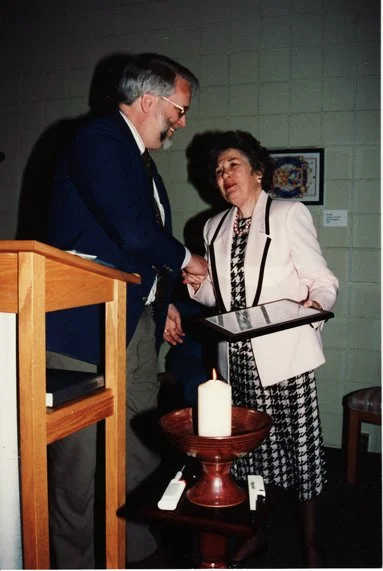
Bob Swanson and Liz Winder on a Easter Sunday circa 1990s. Liz is receiving a Pro Choice Award. (2007.0025)
That same steadying function is visible in 2026, where regular board updates and an annual report intended to "highlight accomplishments, activities, and contributions to the life and mission of UU Lansing" reflect the same commitment to transparency and accountability, whatever the financial moment.
Religious Education
Faith development kept its footing in 1994 under Teresa Putnam's leadership. Her newsletter report was brief and grounded: children were engaged, programming was adapted, hands-on learning was happening. The work continued because someone showed up to do it. The High School group was even planning their own upcoming service — a sign of how broadly responsibility was shared.
The shape looks remarkably familiar in 2026. Programming is adjusted for spring break, a multigenerational Easter egg hunt follows the April 5 service, and the High School group is again preparing to lead their own service on April 12. Volunteers are stepping up for chalice lightings and story readings. The details differ. The commitment doesn't.
Conciliation and Congregational Life
One detail from the 1994 newsletter stands out for what it reveals about the congregation's self-awareness. Following conciliation training, sixteen members noted that the process would "be very beneficial in providing opportunities for resolutions to differences in opinion." In the middle of transition, the congregation was investing not just in programs but in how it handled conflict — in the quality of its internal life.
In 2026, that same attentiveness is visible less in a single formal process and more in the breadth of congregational life—across pastoral care, social justice, hospitality, and community partnerships. The infrastructure of congregational life — the committees, the teams, the relationships — is itself a form of resilience.
Honoring a Departing Minister
The 1994 newsletter included a full flyer for "Celebrating Angie" — a farewell dinner on April 23 honoring Rev. Dr. Theisen, complete with dinner by Don Grigg, a "Best Wishes" ceremony, and an evening with the Vee Nash Jazz Quartet. The congregation was navigating uncertainty and celebrating a person at the same time. Grief and gratitude, it turns out, aren't opposites.
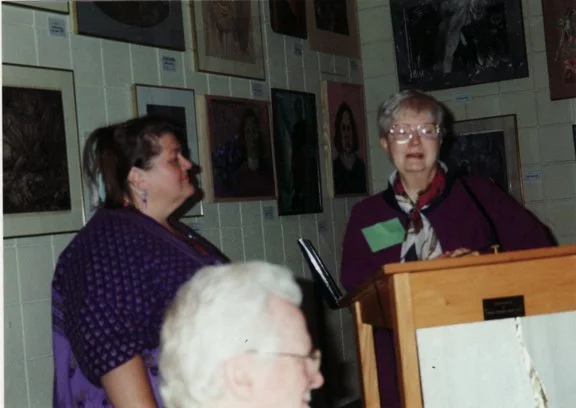
Rev. Dr. Angeline Theissen and Rev. Maryell Cleary in 1994. (2008.0554)
In 2026, a farewell gathering hosted by church members on March 21 offered a similar moment — a chance to honor the person leaving while affirming that the congregation moves forward together. The forms differ across thirty years. The impulse is the same.
Community Engagement
In 1994, the congregation organized a Gospel and Folk Concert on April 9 featuring the Laymen League Chorus of the Union Missionary Baptist Church, alongside vocalists Sharon Lawrence, Carrie Alexander, and Pam Sisson. The connection had roots: chorus member Grady Porter, a former Ingham County Commissioner, had spoken at the church on Martin Luther King Sunday, and the concert grew directly from that relationship. The newsletter was explicit about the purpose — building bridges across racial lines in greater Lansing — and equally direct about what was needed: the biggest thing, it noted, was simply for lots of people to show up. At a moment when the church could have turned inward, it looked outward instead.
In 2026, that same outward orientation is visible across multiple partnerships. The Blessing Box, now active since 2018 and recently strengthened with a dedicated team, provides daily support to neighbors in need. The congregation hosts the RDC Newcomer Center, welcoming refugees and immigrants into the life of the building. And through connections with the Justice League of Greater Lansing and the Family Participation Program — which supports families with incarcerated loved ones — the church continues to show up for the wider community, even while navigating change closer to home.
Conclusion
What the March 1994 Liberal Express ultimately documents is a congregation that kept going — not despite uncertainty, but through it. Worship. Governance. Religious education. Conflict resolution. Honoring those who served. Community engagement. All of it continued, carried by lay leaders, volunteers, and members who chose participation over waiting.
Thirty years on, the structures have evolved and the context has changed, but the underlying pattern holds. The address has changed too — from Grove Street in East Lansing to Pennsylvania Avenue in Lansing — but the congregation has carried these patterns with it. Shared leadership, continued activity, engagement across congregational life — these aren't responses unique to 2026. They're what this congregation does.
Spring, it turns out, keeps happening.
Seeking Your Input
If you were part of the congregation during this period, your memories matter to this project. What do you remember about how the church responded to the 1994 transition? How did it feel from the inside — in worship, in religious education, in the hallways before and after services?
Written recollections are welcome, as are photos, bulletins, letters, or home recordings you may have held onto. Even fragments help. If you have something to share, or simply a story you've never written down, please reach out at uucgl.archives@gmail.com.
Acknowledgment
This post was researched and written by Ed Busch. AI writing assistants — Claude and ChatGPT — were used to help organize and refine the presentation of archival content. The research, archival work, and interpretive judgments are his own.
About the Author
Ed Busch is a member of the Unitarian Universalist Church of Greater Lansing and serves as the volunteer archivist for the congregation. He is retired from Michigan State University, where he worked in digital preservation and archives.
Through the UU Lansing Archives project, he enjoys uncovering stories from church newsletters, board records, photographs, and local history sources to help connect the congregation’s past with its present.
Ed also serves on the UU Lansing Stewardship Team and helps with Building and Grounds projects. He is currently working with other members of the congregation on landscaping and preparations for the dedication of the church’s historical marker on May 31.
Sources
Primary source for this post:
• Liberal Express, March 28, 1994, Unitarian Universalist Church of Greater Lansing
Additional context:
• UU Lansing Weekly Newsletter, March 27, 2026
All materials are preserved in the UU Lansing Archives.