
We’ve Been Here Before: A Look Back at 1994 at UU Lansing
How our congregation navigated a difficult transition—and what the archives show us today.
by Ed Busch, UU Lansing Church Archivist
On March 16, 1849, the First Universalist Church in Lansing was legally established. For 177 years, our congregation has experienced many seasons — times of growth, transition, challenge, and resilience.
Throughout that long history, the congregation has experienced both joyful milestones and moments of difficulty and change.
As I write this in March 2026, our congregation is again navigating a time of change following the announcement that our minister, Rev. Neal Anderson, has resigned after discussion with the Board. In his letter to the congregation he wrote that the Board had “lost confidence in my continuing in the role of Senior Minister,” and that they had agreed together that concluding his ministry was the most responsible path forward for the well-being of the congregation.
Moments like this can feel unsettling for a congregation. The archives rarely tell the full emotional story of such a time — but they do show that the life of the congregation continued, much as it does today.
Looking back helps us see the longer story of our congregation.
One such time occurred in 1994, during the final year of the ministry of Rev. Dr. Angeline E. M. Theisen, who served this congregation from 1987 to 1994.
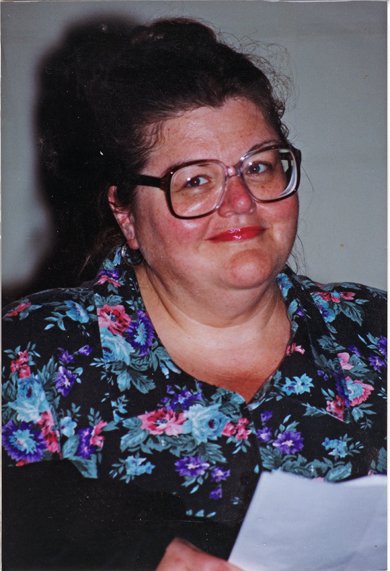
Rev. Dr. Angeline Theisen, October 26, 1991. (2007.001)
A Difficult Time in the Early 1990s
In the early 1990s the church experienced a period of significant internal conflict. Shirley Beckman later wrote in Dedicated Lives:
“The year 1992 was the start of a difficult time for our church. There were divisions within the congregation and between the minister and members of the congregation. Fifteen months were spent in attempts to address the conflicts.”
Rev. Dr. Angeline E. M. Theisen addressed the situation directly in a letter to the congregation dated January 25, 1994:
“As most of you are aware, we have experienced deep divisions in our congregation for the past 15 months… Despite these efforts and more, the prospect of future harmony seems no closer.”
The Board accepted Rev. Dr. Theisen’s resignation in January 1994.
At the time, the church’s president was Bob Swanson and the Director of Religious Education was Teresa Putnam — both of whom remain active members of UU Lansing today.
At the congregational meeting on January 30, 1994, President Swanson explained that the Board had negotiated a resignation agreement with the minister. The agreement was contingent on adoption of the church’s 1994 budget. After discussion, the congregation approved the revised budget with nearly unanimous support.
“We must move forward now in a way that's positive.”
— Bob Swanson, Congregational Meeting, January 30, 1994
The church leadership then began planning the next steps toward forming a search committee and calling a new minister.
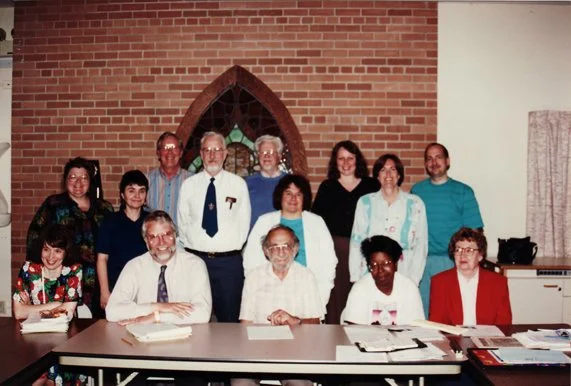
Board of Trustees 1993-1994- Seated - Lynn Scott, Bob Swanson, Frank Pinner, Alex Walker, Eunice Beck. Standing - Angeline Theissen, Jody Valley, Jim Davis, Blake Smith, Ben Bohnhorst, Janet Howes, Regina Fry, Kathy Lovell, Jim Rojeski. (2007.0039)
Life of the Church Continued
Even during that difficult time, the everyday life of the congregation went on.
The February 1994 issue of the church newsletter, The Liberal Express, shows a congregation still gathering, learning, and supporting one another.
From the February 1994 Newsletter
Some of the activities and events taking place in the congregation included:
• Food Communion – A service exploring how sharing meals symbolizes our connection to humanity and the natural world.
• School Finance Proposals Discussion – Bob Swanson spoke about Michigan’s school finance proposals ahead of the March ballot initiative.
• Bloomfield Hospice Presentation – Kay Thorsteinson spoke about hospice care and community support.
• Choir and Youth Choir rehearsals continued the musical life of the congregation.
• Small groups and gatherings included the Women’s Book Reading Group, Men’s Group, Singles Group, and the “Building Your Own Theology” discussion series.
These glimpses from the newsletter show that while church leadership was addressing serious issues, the ordinary rhythm of congregational life continued.
Religious Education in 1994
Religious Education also remained an active and vibrant part of church life.
Director of Religious Education Teresa Putnam, along with Associate Director Lisa Preston, reported in the newsletter about the week’s classes. Preschool children were learning about the human body, while the kindergarten and first-grade class explored the origins of their names and even held a mock baby dedication ceremony.
These small snapshots from the newsletter show that even in times of institutional challenge, the core work of the church — nurturing children, building relationships, and fostering learning — continued.
What Came Next
History shows that the congregation did not simply survive that period — it ultimately flourished.
Following Rev. Dr. Theisen’s departure, the church entered a period of transition. Interim leadership helped guide the congregation as it prepared to call a new settled minister.
In the years that followed, the congregation was served by ministers including Rev. Dr. Barbara Edgecombe and Rev. Kathryn Bert, and later by Rev. Neal Anderson.
During those years the congregation continued its work, strengthening its governance, expanding community partnerships, and caring for its physical and spiritual home. The congregation also undertook projects that reflect its commitment to preserving and sharing its history — including the installation of the church’s historical marker.
Looking back now, the challenges of the early 1990s appear as one chapter in the longer history of the congregation.
A Long Tradition of Renewal
Our congregation has existed for 177 years. Across that time there have been many seasons — joyful and difficult alike.
Transitions in ministry can be challenging, but they are also part of the life of a living congregation. The historical record shows that our congregation has faced similar moments before.
Looking back at 1994, what stands out is how much of the ordinary life of the congregation continued — services, children in RE classes, committee meetings, members showing up for one another. That continuity is its own kind of story.
Do You Remember This Time?
If you were part of the UU Lansing community during the early 1990s, we would love to hear your memories.
What do you remember about the life of the church during that time? Were there services, events, or people that stand out in your mind?
Sharing these memories helps enrich our understanding of the congregation’s history and preserves stories that might otherwise be lost.
You can share your recollections by sending an email to uucgl.archives@gmail.com.
About the Author
Ed Busch is a member of the Unitarian Universalist Church of Greater Lansing and serves as the volunteer archivist for the congregation. He is retired from Michigan State University, where he worked in digital preservation and archives.
Through the UU Lansing Archives project, he enjoys uncovering stories from church newsletters, board records, photographs, and local history sources to help connect the congregation’s past with its present.
Ed also serves on the UU Lansing Stewardship Team and helps with Building and Grounds projects. He is currently working with other members of the congregation on landscaping and preparations for the dedication of the church’s historical marker on May 31.
Sources
Rev. Dr. Angeline E. M. Theisen’s letter to the congregation dated January 25, 1994; congregational meeting minutes from January 30, 1994; church newsletters from early 1994; Rev. Neal Anderson’s letter to the congregation dated March 3, 2026; and the congregational history Dedicated Lives: 162 Years of Liberal Ministry and Its Ministers in Lansing, Michigan 1849–2011 by Ed Busch, Shirley Beckman, and Harry Schwarzweller.
Editorial note: AI writing assistants (ChatGPT and Claude) were used to help review and refine drafts of this article.